
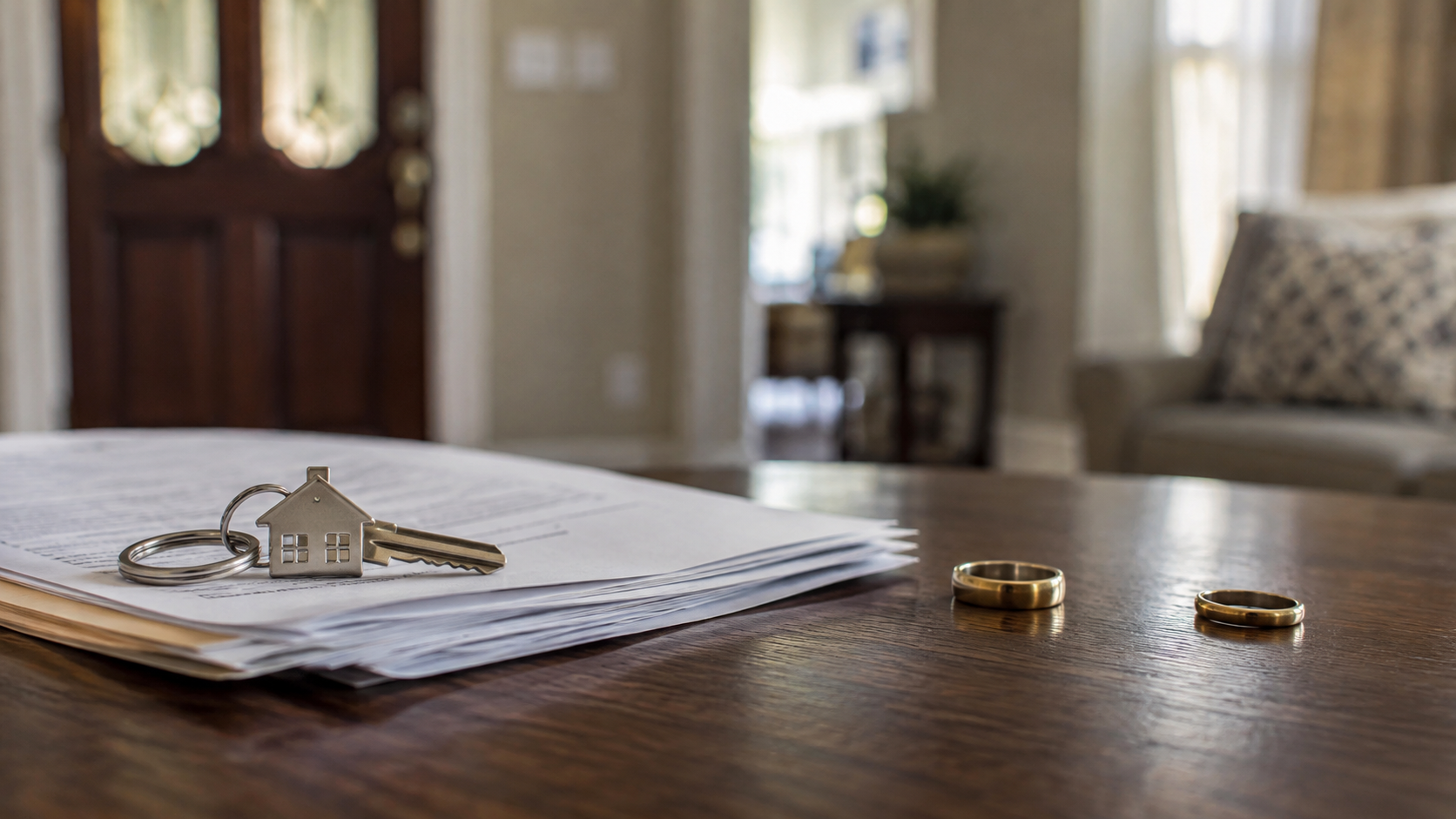
For many divorcing couples, no asset creates more difficult decisions than the family home.
The house may be one of the largest assets in the marital estate, but it is also where children live, where a family built memories, and where one or both spouses may strongly want to remain. At the same time, keeping the house after divorce can create significant financial challenges involving the mortgage, taxes, maintenance, refinancing, and a buyout of the other spouse’s equity.
So, who gets the house in a New Jersey divorce?
There is no rule that automatically gives the home to the husband, wife, higher earner, lower earner, or parent who spends more time with the children. New Jersey applies the principles of equitable distribution, and the appropriate outcome depends on the property’s history, value, debt, the parties’ finances, children’s needs, and whether either spouse can realistically afford to keep it.
Russell Law Divorce & Family Lawyers helps clients evaluate the marital home as part of the broader division of assets in a New Jersey divorce.
Quick Answer: Who Gets the House in a New Jersey Divorce?
If the marital home is subject to equitable distribution, several outcomes are possible:
- One spouse keeps the home and buys out the other’s interest
- The house is sold and the net proceeds are divided
- The spouses continue owning the property temporarily
- Sale is delayed for a defined period, sometimes because of the children
- One spouse receives the home while the other receives different marital assets of comparable value
If the spouses cannot agree, the court may ultimately determine how the property will be treated.
New Jersey is an equitable distribution state. This means marital property is divided fairly based on statutory factors; it does not guarantee an automatic 50/50 split. See the New Jersey equitable distribution criteria.
Is the House Marital Property?
Often, yes—but not always entirely.
A home purchased during the marriage with marital funds will generally be part of the marital estate even if only one spouse’s name appears on the deed. New Jersey’s equitable distribution law focuses on property acquired during the marriage rather than simply whose name appears on an account or title.
The analysis can become more complicated when:
- One spouse owned the home before the marriage
- One spouse inherited the home
- A spouse used inherited or premarital funds for the down payment
- Marital funds were used to pay down a premarital mortgage
- The house was substantially renovated during the marriage
- The property increased considerably in value
- Ownership was transferred or retitled
- Family members contributed money toward the purchase
- The property is held through a trust, LLC, or other entity
A premarital or inherited interest may remain separate property, but contributions made during the marriage can create valuation and tracing issues.
In a high-net-worth divorce, those issues can become particularly important when the family owns several residences, investment properties, or homes with substantial appreciation.
Does It Matter Whose Name Is on the Deed?
Title is important, but it does not necessarily determine whether the property is marital.
A spouse should not assume, for example, that they have no interest in a home solely because the deed is in the other spouse’s name. Likewise, being on the deed does not answer every question about how much of the property’s value is subject to division.
The circumstances surrounding the acquisition and funding of the property matter.
The deed does become critically important when the divorce settlement is implemented because ownership must ultimately correspond with whatever the spouses or court decide.
How Is the Equity in the Marital Home Calculated?
The basic concept is straightforward:
Home value – outstanding secured debt = equity
Suppose a home is worth $900,000 and has a $400,000 mortgage. Before considering other adjustments or sale expenses, there is approximately $500,000 in gross equity.
In practice, the calculation can become more complicated.
Potential adjustments include:
- A home-equity loan or HELOC
- Tax liens
- Other liens against the property
- Expected broker commissions
- Transfer or closing costs
- Necessary repairs
- Separate-property claims
- Reimbursements or credits claimed by either spouse
The first major step is therefore establishing a reliable value.
How Is a Home Valued During Divorce?
An appraisal is commonly used when the spouses cannot agree on value or when the home represents a significant portion of the marital estate.
The parties may:
- Agree on a single neutral appraiser
- Each retain their own appraiser
- Agree on a value based on multiple appraisals
- Negotiate a value based on other reliable market information
Online home estimates can be useful as a starting point, but they may not be precise enough when hundreds of thousands of dollars of equity are at stake.
The relevant valuation date can also become important when the market changes significantly during a lengthy divorce.
Option 1: Sell the House and Divide the Proceeds
Selling the property is often the cleanest financial solution.
After the mortgage and appropriate sale expenses are paid, the remaining proceeds can be allocated as part of the overall equitable distribution settlement.
A sale may make sense when:
- Neither spouse can afford the home individually
- Both spouses want their share of the equity
- The house is too expensive to maintain
- A refinance or assumption is not feasible
- There is substantial equity that both spouses need to establish new homes
- Neither party wants continued financial ties to the other
Selling also avoids the risk of one spouse remaining liable on a mortgage secured by a property they no longer own.
That does not mean the proceeds must automatically be split exactly 50/50. The proceeds are part of the overall marital estate and can be allocated in conjunction with other assets and liabilities under New Jersey’s equitable distribution principles.
Option 2: One Spouse Buys Out the Other
A buyout allows one spouse to remain in the home while compensating the other for their interest.
For example, if the parties agree that the marital equity is $500,000 and each is ultimately entitled to $250,000 of that equity, the spouse keeping the home may need to compensate the other spouse for $250,000.
That does not necessarily require writing a $250,000 check.
A settlement can sometimes use other marital assets to offset the buyout. For example, one spouse may keep more home equity while the other receives a larger share of:
- Cash
- Brokerage assets
- Retirement funds
- Business interests
- Other real estate
- Other marital property
This can be particularly useful when the parties have substantial assets but limited cash.
However, different assets can have very different tax consequences and liquidity. $300,000 of home equity is not necessarily economically identical to $300,000 in a pretax retirement account.
Keeping the House Requires More Than Dividing the Equity
One of the most common divorce-planning mistakes is focusing on who can acquire ownership of the house without asking whether that spouse can actually afford it afterward.
The carrying costs may include:
- Mortgage payments
- Property taxes
- Homeowners insurance
- Utilities
- Repairs
- Landscaping
- Association fees
- Major capital improvements
- Emergency maintenance
A spouse who could comfortably afford half of those costs during marriage may struggle when paying them alone.
The desire to keep children in the same home or neighborhood is understandable, but the long-term budget should be evaluated before agreeing to a buyout.
Does the Spouse Keeping the House Have to Refinance?
Not necessarily.
Refinancing is a common method of removing the departing spouse from the mortgage, but it is not the only possible route.
Fannie Mae explains that, depending on the loan and circumstances, a spouse who receives a home through divorce may potentially continue the existing mortgage or pursue an assumption and request a release of liability for the former spouse. Eligibility depends on the mortgage and servicer requirements. See Fannie Mae’s guidance on transferring home ownership after divorce.
This can be particularly important when the existing mortgage has a substantially lower interest rate than a new loan would.
However, an assumption does not automatically release the other spouse from liability. The mortgage servicer generally must approve a release, and the spouse keeping the property may have to satisfy credit and financial requirements.
The Deed and the Mortgage Are Two Different Things
This distinction is extremely important.
The deed determines ownership of the property.
The mortgage note determines responsibility to the lender.
A divorce agreement or deed transfer may give one spouse 100% ownership of the home, but that does not automatically remove the other spouse from the mortgage.
If both spouses remain liable on the loan and payments are later missed, the lender may still pursue the borrower who no longer owns the home, and the delinquency can affect that person’s credit.
A settlement should therefore address both ownership and loan liability.
What Happens if the Spouse Keeping the Home Cannot Qualify for a New Loan?
That problem should ideally be discovered before the settlement is finalized.
Possible solutions may include:
- Selling the home
- Allowing additional time to refinance
- Exploring an available mortgage assumption
- Adjusting the buyout
- Using other assets to reduce the mortgage balance
- Temporarily maintaining joint ownership under carefully defined terms
The appropriate approach depends on the parties’ finances and tolerance for continuing financial ties.
A provision stating simply that one spouse “will refinance” may be inadequate if that spouse ultimately cannot qualify.
Can Divorcing Spouses Continue Owning the House Together?
Yes, if they agree—or in some situations as part of an interim arrangement—but continued co-ownership creates risks.
A deferred-sale agreement should address issues such as:
- Who lives in the property
- Who pays the mortgage
- Who pays property taxes and insurance
- Responsibility for ordinary repairs
- Responsibility for major improvements
- Whether either spouse receives credits for payments
- How the property will eventually be valued
- When it must be sold
- What events trigger an earlier sale
- What happens if a payment is missed
- How decisions about repairs or listing price are made
Without clear terms, delaying the sale can simply postpone the conflict.
Do Children Determine Who Gets the House?
Children can be an important consideration, but the custodial parent does not automatically receive the home.
New Jersey’s equitable distribution criteria specifically allow the court to consider the need of a parent with physical custody of a child to own or occupy the marital residence. That is one factor among many.
Keeping children in the same house may preserve continuity in their school, neighborhood, and daily routines.
But the arrangement still needs to be financially realistic.
A court or negotiating spouse may also consider whether similar stability can be achieved through another residence without imposing an unsustainable financial burden.
Who Pays the Mortgage While the Divorce Is Pending?
The answer depends on the existing financial arrangement, interim agreements, and any temporary court orders.
One spouse may remain in the house while both continue contributing toward expenses. In another case, the spouse living there may assume more of the carrying costs. Mortgage payments may also intersect with temporary support and claims for credits or adjustments during equitable distribution.
A spouse should be cautious about simply stopping mortgage payments because they moved out. If their name remains on the loan, missed payments can affect their credit regardless of who occupies the house.
This is one reason property and financial issues often become central in a contested divorce.
What Are the Tax Consequences of Transferring a House in Divorce?
Federal tax law generally provides that no gain or loss is recognized when property is transferred between spouses or between former spouses incident to divorce.
The receiving spouse generally takes the transferor’s existing tax basis rather than receiving a new basis equal to the home’s current market value. See IRS Publication 504.
That distinction can have major consequences.
Suppose a couple owns a home now worth $1.5 million but their adjusted tax basis is only $600,000. If one spouse receives the entire property, that spouse may also inherit the potential future tax consequences associated with the low basis.
A settlement should therefore evaluate after-tax value, not simply current appraised value.
Tax advice should come from a qualified tax professional familiar with the specific circumstances.
What if the House Was Purchased Before the Marriage?
A home owned before marriage may contain a separate-property component.
However, the analysis may become more complicated if marital funds were later used to:
- Pay the mortgage
- Make major renovations
- Expand the property
- Pay down home-equity debt
- Make improvements that increased value
The source of funds and reason for any appreciation may need to be examined.
Records such as the original closing statement, mortgage history, appraisal reports, renovation invoices, bank statements, and proof of premarital contributions can become important.
What if Inherited Money Was Used to Buy the House?
Inheritance received individually is generally treated differently from marital property under New Jersey equitable distribution law. But tracing can become more difficult when inherited funds are used to purchase or improve the marital residence or are mixed with marital funds.
The spouse asserting a separate-property claim should preserve records documenting:
- The inheritance
- The account into which it was deposited
- Transfers from that account
- Closing documents
- Down payment
- Renovation expenses
Large transactions should be evaluated carefully rather than assuming the entire house is either marital or separate.
What About Vacation Homes and Investment Properties?
The same broad equitable-distribution principles apply, but additional issues may arise.
Vacation and investment properties can involve:
- Rental income
- Depreciation
- Capital gains
- Property-management agreements
- Business entities
- Out-of-state property
- Short-term rental revenue
- Significant appreciation
- Family ownership arrangements
In high-value cases, the marital home may be only one piece of a larger real-estate portfolio.
These properties should be considered as part of the overall marital estate rather than negotiated one at a time without considering taxes, debt, income, and liquidity.
Should You Keep the House After Divorce?
The answer is not purely legal.
Keeping the home may make sense when:
- You can comfortably afford it
- It provides meaningful stability for the children
- The mortgage terms are favorable
- You can compensate your spouse without sacrificing essential liquidity
- The home fits your long-term financial plans
Selling may be better when:
- Carrying costs are excessive
- Most of your net worth would be trapped in the home
- Refinancing creates an unaffordable payment
- The buyout would require giving up too many retirement or investment assets
- Continued ownership would create unnecessary financial ties
An emotionally desirable asset can still be a poor financial asset after divorce.
Can the House Be Resolved Through Mediation?
Yes. The marital residence is frequently addressed through negotiation or divorce mediation.
Mediation may give spouses more flexibility to structure a sale, buyout, deferred sale, or asset offset than they may receive through a litigated result.
That flexibility is most useful when both parties have reliable information about value, mortgage debt, taxes, and their post-divorce budgets.
Talk to Russell Law About the Marital Home in a New Jersey Divorce
Deciding what happens to the family home requires more than determining who wants it more.
The property must be valued, equity must be calculated, mortgage liability must be addressed, and the decision should fit into the broader financial resolution of the divorce.
Russell Law Divorce & Family Lawyers represents clients in property-division matters ranging from straightforward marital residences to complex real-estate holdings and high-value marital estates.
If you are concerned about keeping, selling, or protecting your interest in a home during divorce, speak with Russell Law about your options before agreeing to a transfer or buyout.
Frequently Asked Questions About the House in a New Jersey Divorce
Does the wife automatically get the house in a New Jersey divorce?
No. New Jersey does not automatically award the home based on gender. The result depends on equitable distribution, the parties’ finances, children’s needs, the home’s history, and other circumstances.
Is home equity always divided 50/50?
No. New Jersey uses equitable distribution, which means fair rather than automatically equal. Home equity is also considered in conjunction with the rest of the marital estate.
Can I keep the house if both names are on the mortgage?
Potentially, but transferring ownership does not automatically remove the other spouse from the mortgage. Refinancing, assumption, or another lender-approved release of liability may be necessary.
Do I have to refinance the mortgage after divorce?
Not always. Some loans may permit assumption and release of liability, depending on the mortgage and servicer. Refinancing remains one common way to remove a former spouse from the loan.
What if my spouse owned the house before we married?
The premarital interest may be separate property, but mortgage payments, renovations, appreciation, and marital contributions can complicate the analysis.
Are transfers of the house between spouses taxable during divorce?
Federal law generally does not recognize gain or loss on a qualifying transfer between spouses or former spouses incident to divorce. The receiving spouse generally takes the existing tax basis, which can affect a later sale.